

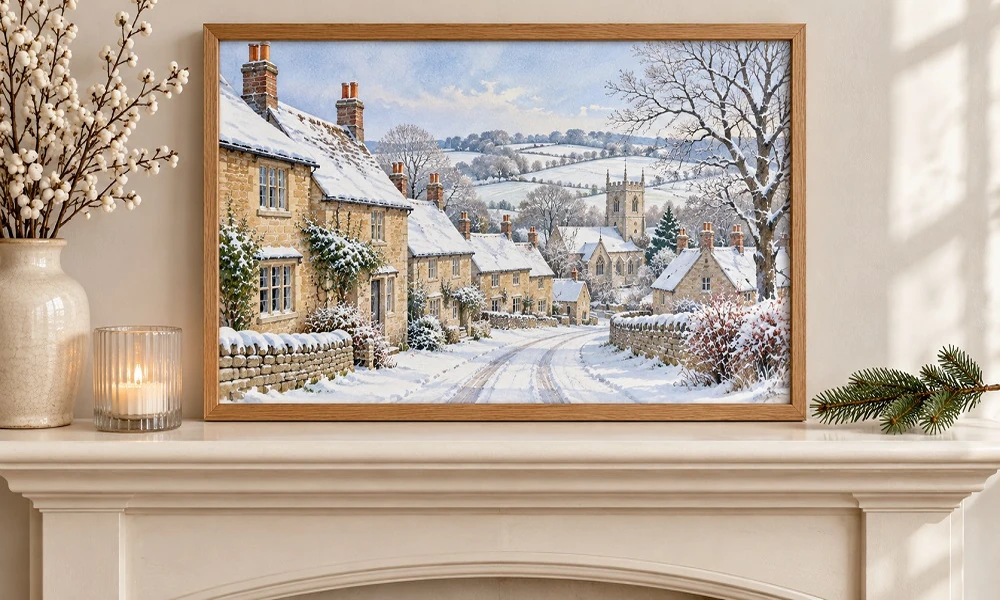
The easiest way to lose a chimney is to measure the backing board and forget the lip of the frame. Start this Christmas village with an empty frame laid flat on the table. The opening tells you how tall your cottages can be, where the street should run and whether there’s room for one last tree. Once those decisions are made, you can build the whole scene from a handful of cutouts.
1. Choose A Frame And A Few Good Neighbors
A landscape frame gives a row of cottages room to spread out. A small portrait frame makes a lovely doorway scene, especially if you have one tall building you want people to notice. Remove the backing and glass, if present. Set the glass aside and cut a smooth, rigid panel that fits the same recess. Check that the retaining tabs still close with the new panel in place.
For the artwork, look for an IOD Transfer at Milton’s Daughter with buildings that make sense beside one another. In the 2026 winter transfer collection, artist Marian Parsons drew on photographs from her travels in the Cotswolds. Her A Cotswold Christmas sheets are a good starting point if you like stone cottages and the muted colors of an English winter.
Gather scissors, plain paper, a pencil, the rubbing tool supplied with the transfer and a clean, soft cloth. Choose a pale background paint suitable for the panel. Warm ivory gives a snow scene a little light even when the frame sits on a shelf away from the window.
2. Give The Village A Street
Trace the inside opening of the empty frame onto plain paper. Keep each motif on its protective backing while cutting around it, then arrange the pieces inside that outline. Start with the largest cottage. Place it just left or right of center and give its front door a little open ground. Now add a smaller neighbor. If both doors look as though they open onto the same lane, the scene is already doing its job.
Try the layout upright before committing. A roof that almost touches the upper edge can feel cramped once the frame casts a shadow. Slide the houses down a little, or swap the tallest one for a shorter cottage. Take a quick picture of the arrangement. It will save you from having to remember which way a tiny branch pointed.
3. Prepare The Panel And Rub Down The Design
Paint the panel and let the finish dry and cure as directed for the products you chose. Run a clean cloth over the surface to pick up dust. If the paint feels chalky or sheds pigment, check the package directions for a compatible sealer before applying the design. Iron Orchid Designs’transfer application guidance explains how to check that a detail has released before pulling its carrier away.
Work with one piece at a time. Peel away its protective backing, hold the clear carrier above the panel and lower it into position. Keep a hand on the carrier as you rub the image with the tool. Lift one corner slowly. If a window or chimney is still on the film, lower that corner into the same spot and rub the missing detail again.
Burnish the released image gently with the cloth. For overlapping motifs, complete the distant building first and place the foreground detail last. A branch crossing the corner of a roof can tie two pieces together. Leave the doorway clear so the eye still has a way into the picture.
4. Check The Edges And Close The Frame
Set the empty frame over the panel and stand back. If the houses seem to float, try a spare shrub at the foot of one wall. If the street already reads clearly from across the room, put the extra pieces away. Small offcuts can decorate a gift tag that echoes the framed scene.
Follow the transfer directions for the final protective finish and let it dry as directed before assembly. If you reinstall the glass, use a mat or suitable frame spacers to keep it clear of the decorated surface. Secure the backing, turn the picture over and check for specks while you can still open it easily.
For a gift, write the year and a short dedication on the back. For your own mantel, try the frame beside a small evergreen cutting so the painted trees carry into the room. Explore the winter designs at Milton’s Daughter and choose the cottage you’d most like to come home to.
